

Commercial roofing lasts longer and costs less to own when someone checks it on a regular schedule. Most business roofs in Fort Worth are flat roofs or low-slope roofs. Use this guide to plan what gets checked, when, by whom, and what to keep on file.
Why Flat Business Roofs Need a Maintenance Plan
On a sloped home roof, gravity moves water off fast. On a flat or low-slope roof, water has to find its way to drains, scuppers and gutters. When a drain clogs or a seam opens, water can sit on the roof and work its way inside before anyone sees it.
Most roof failures on these buildings start as small problems that grow over time. A loose piece of flashing at a rooftop unit or a clogged drain is a quick fix when someone finds it early. Found later, the same problem can lead to wet insulation, ceiling damage, and a tenant who can't use their space.
A maintenance plan puts the roof on the calendar so problems get caught between storms. Planned upkeep usually costs less than emergency repairs and lost business days. It also gives you a record of the roof's condition, which helps with budgeting, warranty questions and the choice between roof repair and roof replacement.
How Often to Inspect a Flat Roof
For most flat or low-slope roofs on businesses, we recommend an inspection twice a year and after every major storm. Spring and fall work well in North Texas:
Spring catches anything winter left behind and gets the roof ready for hail and severe storm season.
Fall finds damage from summer storms and months of Texas heat and UV exposure ahead of colder weather.
After storms, a quick check can find punctures, torn flashing or blown-off debris while the damage is fresh and easy to document.
Your warranty may also set a schedule. Some manufacturer warranties for these roofs ask the owner to inspect the roof at least twice a year, keep a file of every inspection and repair, and report leaks within a set number of days. Read your warranty, or ask your roofing contractor to walk you through it.
A Seasonal Roof Maintenance Checklist
Use this table to plan each visit. The "who" column assumes your own staff stay off the roof and check from inside and at ground level, while a roofer handles the roof itself.
| Task | When | Who | What to look for |
|---|---|---|---|
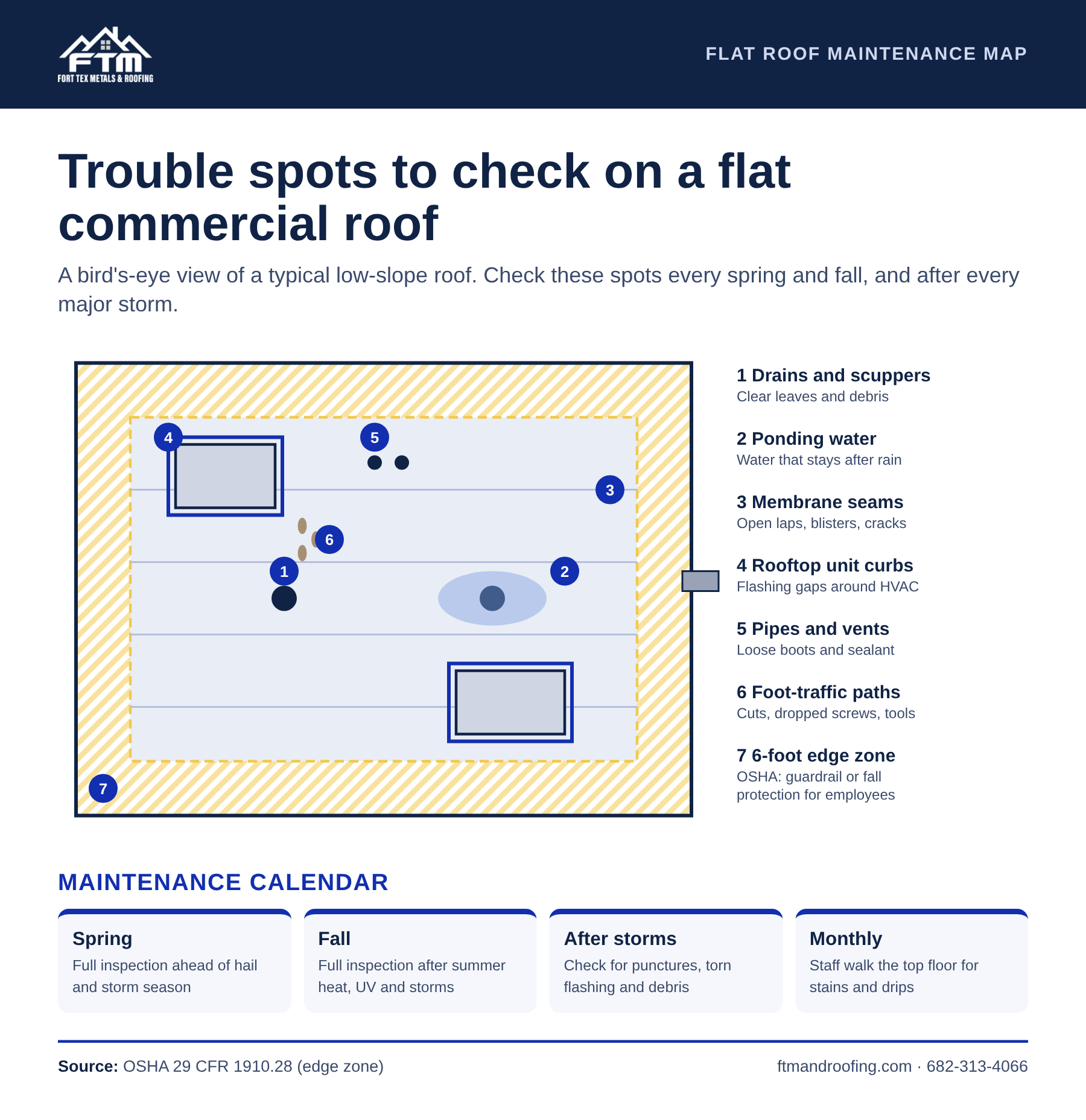
| Clear drains, scuppers and gutters | Spring, fall and after storms | Roofer | Leaves, trash and debris that block water flow |
| Check for ponding water | Spring, fall and after heavy rain | Roofer | Water that stays on the roof long after a storm |
| Inspect membrane seams | Spring and fall | Roofer | Open laps, cracks, blisters or punctures in TPO or other membranes |
| Check flashing at curbs and penetrations | Spring and fall | Roofer | Gaps around rooftop units, pipes, vents and skylights |
| Check metal panels and fasteners | Spring and fall | Roofer | Loose or backed-out fasteners, worn sealant, rust at cut edges |
| Look for foot-traffic damage | After any rooftop service visit | Roofer | Cuts, dropped tools or screws near HVAC units |
| Walk the top floor | Monthly | Your staff | Ceiling stains, drips, musty smells |
| Log findings and repairs | Every visit | Your staff and roofer | Date, photos, location and what was done |
What to Check on TPO and Metal Roofs
TPO roofing (thermoplastic polyolefin) is a single-ply membrane that's common on flat and low-slope properties across DFW. Owners often choose it for its UV resistance and energy efficiency. Its weak points are the seams, where sheets are heat-welded together, and the spots around rooftop units where service techs walk and set down tools. A small puncture in TPO can let water spread under the membrane, so the leak inside may show up far from the hole.
Standing seam and other metal roofing materials have fewer seams to fail, but they move as they heat up and cool down. Over time, fasteners can back out, sealant can dry and crack, and cut edges can start to rust. Checking these spots twice a year keeps a small repair from turning into panel replacement.
Both systems share the same trouble spots: flashing, penetrations, edges and drainage.
Who Should Go on the Roof
Your maintenance staff can do a lot from inside. Walking the top floor to look for stains, checking the ceiling under rooftop units, and reporting drips quickly are all useful jobs that still keep people off the roof.
Roof edges are where the risk is highest. OSHA rule 1910.28 covers general industry employees who work on a low-slope roof less than 6 feet from the edge. The employer must protect each one with a guardrail, safety net, travel restraint or personal fall arrest system. Farther from the edge, other rules apply. If your team doesn't have that equipment and training, leave rooftop checks to a roofer.
Limit roof access to people who need to be there, and ask HVAC and other service techs to report any damage they cause. Tools, screws and heavy equipment set down on a membrane roof can puncture it.
Signs It's Time for Repair or Replacement
Maintenance can stretch the life of a roof, but every roof reaches a point where repairs stop making sense. Here's how to tell the difference:
Repair usually fits a localized leak, damaged flashing, or storm damage in one area.
Replacement usually fits widespread leaks, ponding across large sections, wet insulation, or interior water damage that keeps coming back.
A good assessment documents the roof's condition, explains your options, whether that's repair or a new roof installation, and lays out next steps without pushing upgrades you don't need. Your maintenance log will help out here. If the same area has been patched three times in two years, that history makes the decision clear.
How We Help DFW Property Owners
We offer preventative maintenance plans and full roof inspections for commercial properties in Fort Worth, Tarrant County and across DFW. We provide maintenance, repair and replacement for TPO and standing seam metal systems and other commercial metal roofs.
On every inspection, we document the roof's condition with photos and video, explain what we find in plain terms and give you recommendations based on what the property needs. We plan work around your tenants and staff so the business can keep running. See our services for business properties for more.
Commercial Roofing FAQ
How often should a flat business roof be inspected? We recommend twice a year, in spring and fall, plus a check after every major storm. Your warranty may also set an inspection schedule.
What is ponding water? Ponding water is water that stays on a flat or low-slope roof long after it rains. It can point to a clogged drain or a low spot, so have a roofer look at it.
Can my maintenance staff check the roof? They can check ceilings and the top floor from inside. For work on a low-slope roof within 6 feet of the edge, OSHA requires fall protection such as a guardrail or personal fall arrest system.
Does skipping maintenance affect my roof warranty? It can. Some manufacturer warranties require regular inspections and a file of inspection and repair records. Check the terms of your own warranty.
What roof systems are common on DFW businesses? TPO membranes are common on flat and low-slope roofs, and standing seam metal is popular with owners who want long-term durability.
How do I choose between commercial roofing companies near me? Look for a roofing contractor who works on your type of roof system, documents findings with photos, and gives you a written maintenance plan you can keep on file.
Sources: OSHA 29 CFR 1910.28, Duty to have fall protection
A maintenance plan keeps your commercial roofing on schedule and your doors open in any weather. Schedule an inspection or call 682-313-4066 to protect your property before the next storm.