Class 4 Impact Resistant Shingles in North Texas: Are They Worth It?
If you’re replacing your roof in Fort Worth, or anywhere in the DFW area, Class 4 shingles are one of the first upgrades you should consider. Impact resistant shingles are built to withstand harder hail hits than standard asphalt shingles. That label alone doesn’t tell you how a product will actually hold up, so it helps to know how the testing works and what independent research found before you choose.
What Class 4 Impact Resistant Shingles Are and How They’re Tested
“Class 4” is a rating for impact resistance, not a brand or a product line. A shingle earns it by passing a lab impact test at the highest level. There are two common tests in the U.S.:
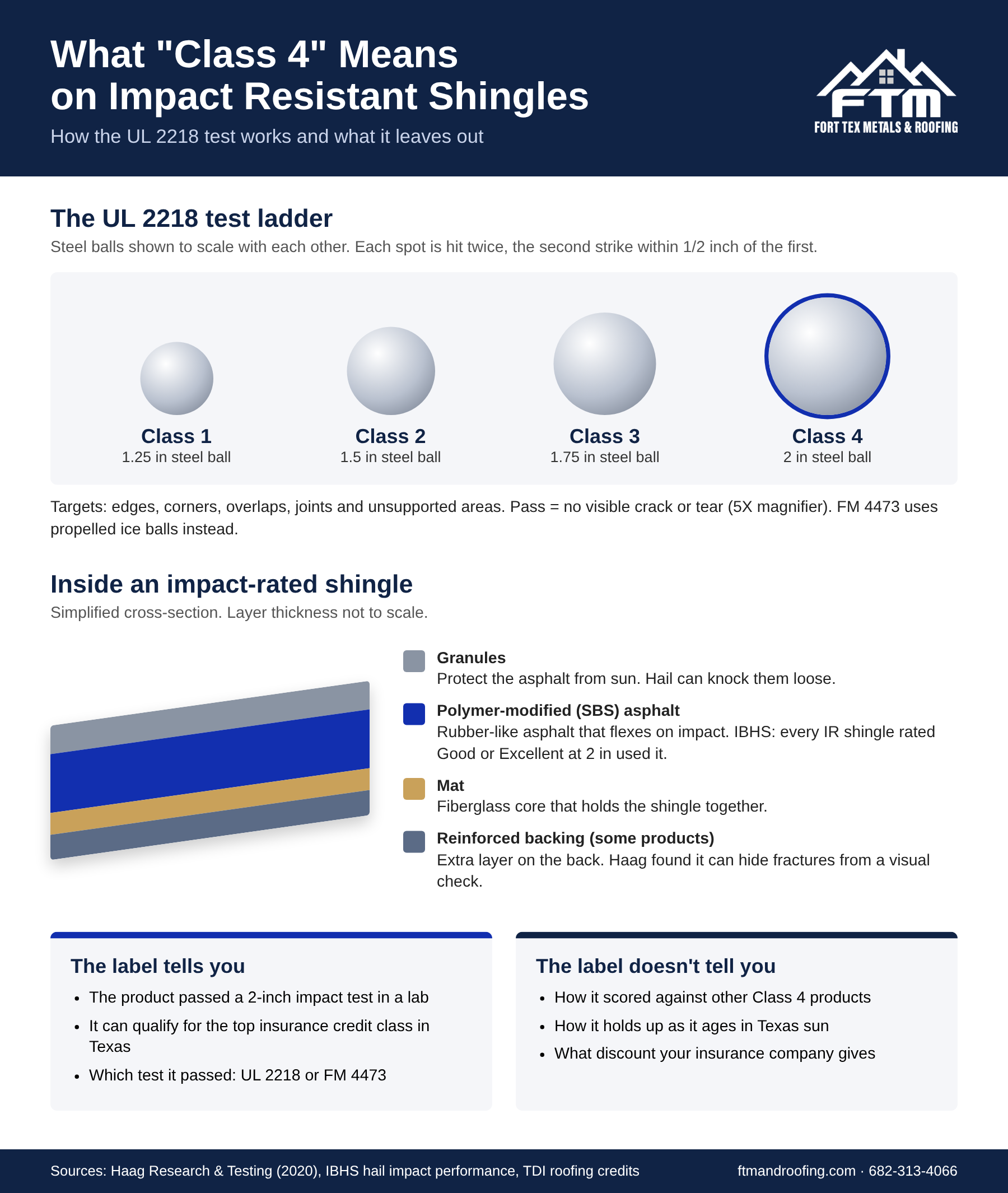
UL 2218. Lab staff drop steel balls onto a roof sample from set heights. The balls are 1.25, 1.5, 1.75 and 2 inches across, and they line up with Class 1, 2, 3 and 4. A Class 4 product has to survive the 2-inch ball.
ANSI/FM 4473. This test fires ice balls at the sample instead of dropping steel. It also grants class ratings, with Class 4 at the top.
According to Haag Research & Testing, a lab in Flower Mound that runs both tests, each spot on the sample gets hit twice, with the second strike landing within half an inch of the first. The test targets edges, corners, overlaps, joints and unsupported areas, since those are the weak points. Passing is based on a visual check for cracks and tears, and UL 2218 adds a 5X magnifier.
Shingles aren’t the only roofing materials that can carry this rating. The Texas Department of Insurance (TDI) lists shingles, tiles, shakes, formed metal panels and sheets as roof coverings that can be tested and classed from 1 to 4.
How Class 4 Shingles Are Built
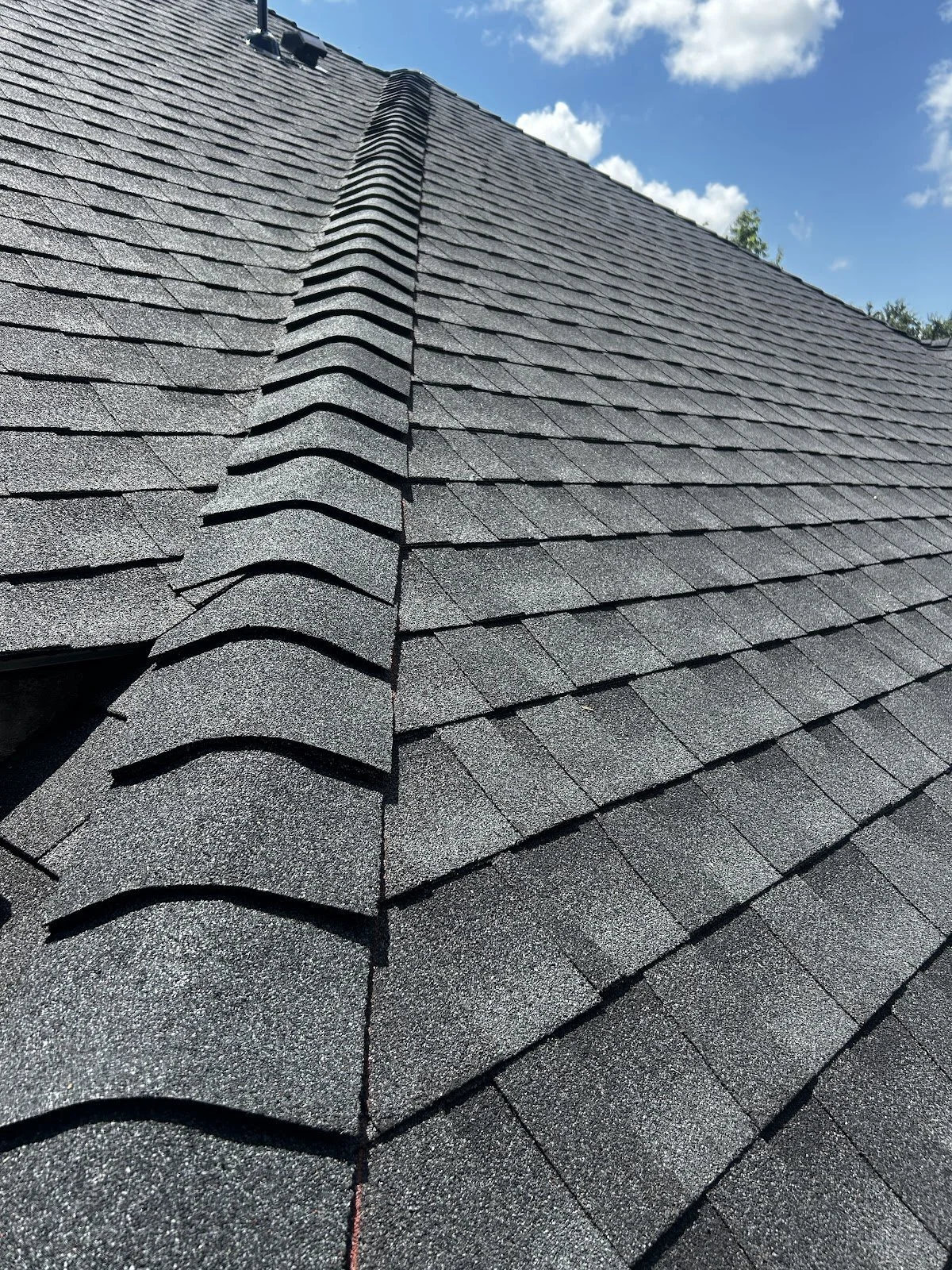
Many Class 4 shingles look like standard architectural shingles from the street. The difference is inside the shingle.
Polymer-modified asphalt. Many impact-rated shingles mix a rubber-like polymer, often called SBS (styrene-butadiene-styrene), into the asphalt. The shingle flexes when hail hits it instead of cracking.
Reinforced backing. Some products add a mat or fabric layer on the back of the shingle to hold it together under impact.
The polymer point is worth asking about. In testing by the Insurance Institute for Business & Home Safety (IBHS), every impact-rated shingle that earned a Good or Excellent score against 2-inch hail used polymer-modified asphalt.
Not Every Class 4 Shingle Performs the Same
The Class 4 test is pass or fail. Two products with the same class label can hold up very differently under hail. IBHS built its own test that uses lab-made hailstones and scores the damage instead of just passing or failing it. Its results showed real gaps between products:
With 1.5-inch hail, every product tested, impact-rated or not, scored Good or Excellent in new condition.
With 2-inch hail, the gap opened up. Where a maker’s impact-rated shingle beat its standard shingle, the Good or Excellent products averaged 14% higher scores, and some reached 34% higher.
In IBHS’s results, each maker with two impact-rated products had one that did worse than its standard shingle. That one used an older design, such as scrim backing.
Dents and ridges were the weakest scores across the board, and new products all scored well for granule loss.
Haag’s 2020 study went further. It tested five impact-rated shingles, four of them rated Class 4. Only two passed Class 4 again in Haag’s lab. When Haag dissolved the asphalt to look at the reinforcement inside, it found fractures in every shingle tested, including some that looked fine from the outside.
Treat the Class 4 label as a starting point, then look at the specific product and how it’s installed. IBHS publishes its ratings and updates them every two years, so you can check how a product scored before you pick it.
Class 4 vs Standard Shingles Compared
| Standard architectural shingles | Class 4 shingles | |
|---|---|---|
| Impact rating | Usually not impact rated | Passed UL 2218 or FM 4473 at Class 4 |
| Typical material | Standard oxidized asphalt | Often polymer-modified (SBS) asphalt, sometimes reinforced backing |
| Hail up to 1.5 inches (IBHS lab, new roof) | Good or Excellent | Good or Excellent |
| Hail around 2 inches (IBHS lab) | Lower scores | Better scores for the top performers, results vary by product |
| Insurance credit in Texas | Only if the product carries an impact class | Highest credit class, amount set by each insurance company |
| Material cost in DFW (IBHS survey) | Baseline | Top performers averaged about 4% more per square |
| Look from the street | Architectural | Usually looks the same |
Cost and Insurance Credits in DFW
What Class 4 Shingles Cost
We price every roof on its size, pitch, tear-off, decking and details, so the only way to know your true costs is getting an estimate for your specific house. IBHS offers one useful data point: in a cost survey across seven U.S. markets, IBHS found that shingles with Good or Excellent impact ratings cost about 9% more per roofing square (100 square feet of material) than standard shingles on average. In the Dallas-Fort Worth market, the gap was only about 4%.
That survey covers material only, not labor or tear-off, so use it to judge the size of the upgrade and then get a real estimate for the total.
Do Class 4 Shingles Lower Your Insurance in Texas?
They can. Insurance providers set the amount, and TDI lays out the ground rules:
Roofing that passes a recognized impact test is classed 1 to 4, and a Class 4 roof covering gets the highest premium credit.
Each insurance company sets its own discount, decides which test results it accepts, and chooses what paperwork it needs from you and your contractor.
For Texas Windstorm Insurance Association (TWIA) policies, the product must carry a UL 2218 label showing the class, maker, year and brand, and the contractor fills out TDI form PC068 after installation.
TDI is also pushing insurers to do more. In a September 16, 2026 bulletin, the commissioner urged Texas home insurers to offer meaningful discounts for impact-resistant roofing and homes built to the IBHS FORTIFIED standard, and to cut down on redundant paperwork.
Before you pick a shingle, call your agent and ask three questions:
Do you give a discount for a Class 4 roof, and how much is it on my policy?
Which test ratings do you accept, UL 2218, FM 4473, or both?
What proof do you need after the roof goes on?
Keep the shingle wrapper or label and your contractor’s paperwork. That’s often what the insurance company asks for.
Are Class 4 Shingles Worth It? Pros, Cons and When to Upgrade
Pros
Better odds of coming through a 2-inch hailstorm or other severe weather with less damage, especially with a polymer-modified product that scores well in IBHS testing
A possible insurance credit, with Class 4 at the top of the scale
A small material cost gap in DFW, based on the IBHS survey
The same look as standard architectural shingles
Cons
Not hail-proof. Very large hail can still damage any shingle.
Results vary between Class 4 products, so the label alone doesn’t tell you enough
Discounts vary by insurance company, and some may offer little or none
Class 4 shingles usually make the most sense when:
You’re replacing the roof anyway, after a claim or because of age, so you only pay the difference in material
Your insurance company offers a real discount you’ve confirmed in writing
You plan to stay in the home long enough for fewer hail repairs and lower premiums to add up
Your roof has taken hail or high winds damage before
They make less sense when your roof is fairly new and in good shape, or when your insurance company offers no credit and you’re planning to sell soon.
A shingle is only one part of the roof. The underlayment, leak barrier, starter strip, ventilation and ridge cap all work together, and you can see how those layers fit in our roof system. If you’re weighing materials for a residential roof replacement, we also install metal roofing, and metal panels can carry impact ratings too.
Class 4 Shingles FAQ
What is the difference between Class 3 and Class 4 shingles? Class 3 products pass the UL 2218 test with a 1.75-inch steel ball. Class 4 products pass with a 2-inch ball, the top of the scale.
Are Class 4 shingles hail-proof? No. They’re tested to resist impacts similar to 2-inch hail in a lab. Larger hail, wind-driven hail and an aging roof can still lead to damage.
Do Class 4 shingles look different? Many look like standard architectural shingles. The difference is in the asphalt and backing inside the shingle.
How much is the insurance discount for Class 4 shingles in Texas? It depends on your insurance company. TDI says each company sets its own discount and paperwork, with Class 4 earning the highest credit. Ask your agent for your number before you buy.
Can metal roofs be Class 4? Yes. TDI lists formed metal panels and sheets among the roof coverings that can be impact tested and classed.
How do I check a shingle’s Class 4 rating? Check the package label for the UL 2218 or FM 4473 class, and look up the product in the IBHS hail ratings to see how it scored in their tests.
Sources: IBHS hail impact performance at a glance · IBHS 2023 hail ratings update · Haag white paper on impact-resistant shingles · TDI: impact-resistant roofing credits · TDI Commissioner’s Bulletin B-0008-26
If you’re replacing a roof in Fort Worth or Dallas this year, ask about impact resistant shingles before you sign. Schedule an inspection and we’ll compare Class 4 shingles, standard shingles and metal for your home, so you can protect your roof before the next hail season.